Structured Interviews: The Complete Guide for Hiring Teams
Most hiring teams believe in structured interviews. Almost none of them do them consistently.
The reason isn't a lack of discipline or training. It's that running truly structured interviews, consistent questions, calibrated scoring, scorecards completed before memory fades, is genuinely unsustainable at any real volume. Add in the flood of AI-generated applications now hitting recruiters' inboxes, and the problem compounds.
A structured interview is a hiring conversation where every candidate is asked the same predetermined questions and evaluated against the same scoring criteria. Research consistently shows structured interviews predict job performance better than unstructured conversations, but most teams struggle to sustain them because scoring consistently and getting evaluations completed before memory degrades is operationally brutal at scale. AI-assisted structured interviewing solves this by generating questions and criteria automatically from the job description, conducting consistent screens across every candidate, and auto-filling scorecards based on what was said, making structured interviewing achievable for the first time without adding to recruiter workload.
What Is a Structured Interview?
A structured interview follows a predetermined format: the same questions, in the same order, for every candidate, with answers scored against a consistent rubric.
That consistency is what makes them work. When every candidate gets the same questions, you're comparing apples to apples. When scoring criteria are defined in advance, evaluators aren't inventing their own benchmarks mid-interview. When scorecards are completed independently before debrief, you limit groupthink and recency bias.
Decades of research in industrial-organizational psychology support this approach. Structured interviews are among the most predictive selection tools in existence, more reliable than unstructured conversations, reference checks, and most personality assessments.
Fully structured vs. semi-structured interviews
A fully structured interview uses a fixed question set with no deviation and a detailed scoring rubric for each response. These are common for high-volume early screening where consistency matters most.
A semi-structured interview has a core set of required questions but allows interviewers to probe or follow up based on candidate responses. These work well for later-stage interviews, where the goal shifts from consistent comparison to deeper exploration.
Both approaches share the same foundation: defined criteria evaluated the same way across candidates.
Example of a structured interview question
A behavioral structured interview question looks like this:
"Tell me about a time you had to deliver a project under a tight deadline. What was your approach, and what would you do differently?"
Each response is then scored against a rubric, for example, a 1–4 scale based on whether the candidate demonstrated planning skills, adaptability, and self-awareness.
The question isn't what makes it structured. The scoring criteria applied consistently to every answer is what makes it structured.
Why Structured Processes Break Down in Practice
The gap between intention and execution in structured interviewing is real, and it has nothing to do with whether recruiters value consistency.
Here's what actually happens:
Scorecards don't get filled in before the debrief. Evaluators discuss candidates first, and the scoring drifts toward confirming what someone already said out loud. A candidate interviewed on Thursday gets evaluated against a sharper memory than the candidate interviewed on Monday. Hiring managers make decisions before anyone has compared candidates on the same criteria.
This isn't a failure of commitment. It's an infrastructure problem. The manual work of capturing consistent signal at every stage, while staying fully present in the conversation, coordinating across evaluators, and filling in documentation afterward, is too operationally expensive to sustain.
According to Elly and HR Chief's 2025 survey of 215 Talent Acquisition professionals, 59% of teams already use AI for interview notes and summaries, but only 20% use AI-driven interviewing tools. Teams are offloading transcription. They haven't yet moved to capturing structured evaluation signal at the source, and that's where the gap lives.
How AI Changes the Infrastructure Equation
The conventional advice on structured interviewing, build better templates, train your evaluators, hold people accountable, treats this as a discipline problem. Elly's argument is that it's an infrastructure problem. And AI is the first tool that actually solves it.
Here's what AI-assisted structured interviewing looks like in practice:
- Automatic question and criteria generation. Elly generates a first-pass question set and scoring rubric directly from the job description. Recruiters review and edit before it goes live, but they're not starting from scratch, and the criteria are tied to the role before the first candidate applies.
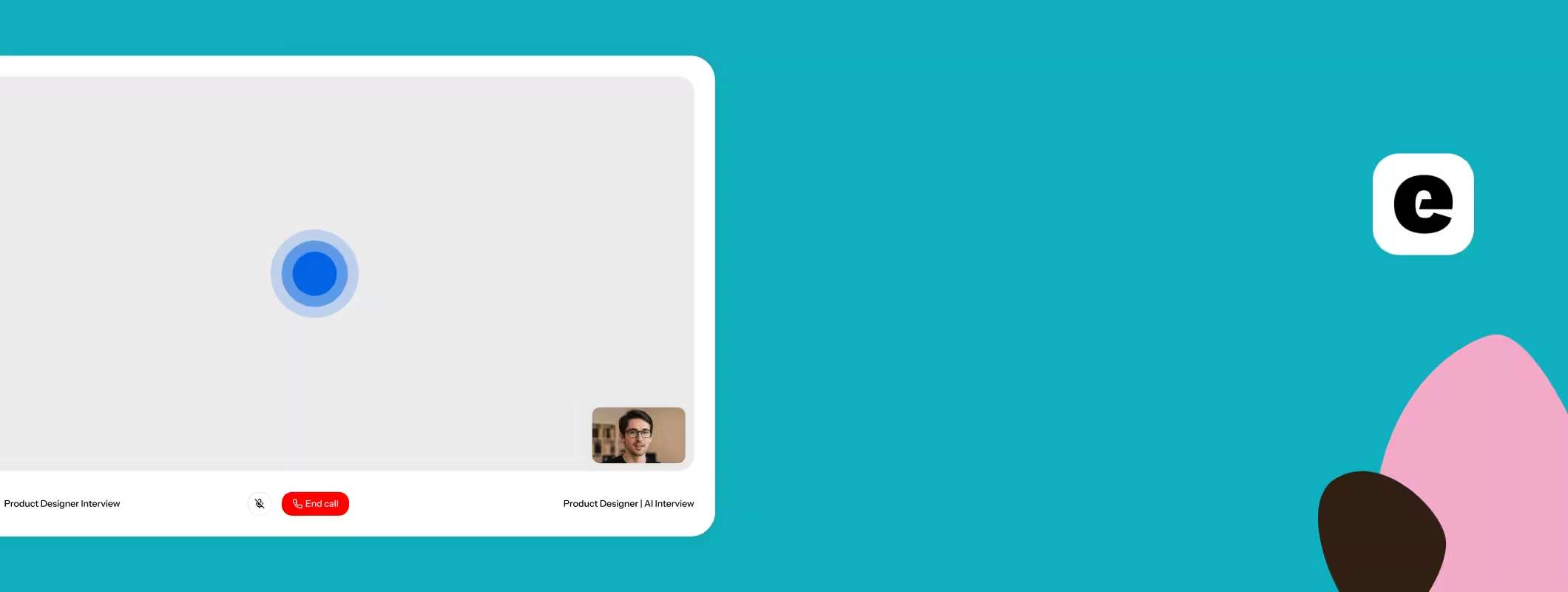
- Consistent screening at scale. Every applicant gets the same structured async interview, the same questions, in the same order, with real-time follow-ups when answers are vague or incomplete. The interview doesn't change based on who conducted it or what day it was.
- Auto-filled scorecards. Rather than asking evaluators to recall and document after the fact, Elly auto-fills scorecard fields based on candidate responses for human review and approval. The scoring happens close to the signal, not days later.
This isn't replacing human judgment. It's removing the operational friction that causes structured processes to collapse under pressure.
"Elly never replaces the recruiter. It gives me more data points so I can make better decisions. I still control the whole pipeline."
Abe Weiser, Head of Talent Acquisition, Elly
Fairness is a real concern in AI-assisted hiring. According to Elly and HR Chief's 2025 research, 42% of TA professionals cite bias or fairness as a top barrier to AI adoption. Elly addresses this directly through a partnership with Warden AI, which independently audits the platform for adverse impact to help teams use AI interviewing with confidence.
The Resume-to-Signal Gap
One thing structured AI screening makes visible is how unreliable resumes are as a primary filter.
Abe Weiser ran a recent search for two engineering roles that received more than 2,000 applicants. Before using Elly's AI Interviewer, he was working through resumes until he found a manageable pool of clear fits, the rest didn't get considered.
"I would get through 50 or 100 resumes until I found 10 to 15 strong candidates. The rest just would not be considered."
Abe Weiser
One candidate's resume placed her firmly in the "maybe later" category, unclear experience, easy to deprioritize. She completed the AI interview. When Abe watched it, she demonstrated a clear understanding of the product, including how Elly uses its own tools internally. That signal moved her from the maybe pile to a live call, and she became one of Elly's two engineering hires.
The inverse is also true. Nat Disston, Operating Partner at Atomic, found that some strong-looking resumes didn't hold up in a structured screen.
"One of the people we hired would not have been the top pick based on resume alone. After hearing him talk in the screener, it was clear he was way more interesting and relevant than what the resume showed."
Nat Disston, Operating Partner, Atomic
Structured AI screening doesn't just evaluate candidates more consistently. It surfaces people who would have been missed.
How Early Screens Make Human Interviews Better
Here's a dynamic that doesn't get talked about enough: structured AI screening doesn't just help you decide who advances. It briefs the human interviewer on who they're about to meet.
When a recruiter or hiring manager enters a live conversation already knowing a candidate's communication style, clarity of thought, and enthusiasm from a structured async screen, the human conversation becomes more targeted and more valuable. You're not spending 15 minutes on background you already have. You're going deeper on the things that matter.
"By the time I got on a live call, I already felt like I knew the candidate. I had read their answers, heard their voice, and seen how they thought about the role."
Nat Disston
That compounding effect, structured AI screen briefing the human interviewer, is something worth naming explicitly. The signal captured early in the process doesn't just evaluate one candidate. It shapes every subsequent conversation.
When to Use Fully Structured vs. Semi-Structured Approaches
Structure matters most where volume is highest and consistency is hardest to maintain manually.
Fully structured AI interviews work especially well for high-volume early screening, roles with many applicants where the priority is evaluating every candidate against the same criteria before any live time is invested. This is where async AI interviewing is most operationally valuable: every application gets a response, every response gets evaluated consistently, and recruiters focus their time on candidates who've already demonstrated fit.
Semi-structured human-led interviews become more valuable as roles get more senior or nuanced. The interviewer can build on what the early screen revealed, following up on specific answers, probing for depth on the things that mattered, tailoring the conversation rather than running the same playbook again.
The two approaches compound well together. AI screening captures baseline signal; human interviews go deeper on what matters most.
If you're not ready to lead with async AI interviews, there's a lower-stakes starting point. As Nat Disston suggested:
"One way to test it is to use it after a recruiter call. You can say I loved our conversation and would like you to complete this so you can tell your story to the broader team. It gives everyone a chance to see the product in action without worrying about losing candidates."
Nat Disston
What Good Structured Interview Questions Actually Look Like
Effective structured interview questions are behavioral or situational, tied to specific competencies, and scored on a defined rubric.
Behavioral questions ask candidates to describe what they actually did: "Tell me about a time you had to navigate a disagreement with a colleague. How did you handle it?" These surface real examples rather than hypothetical answers.
Situational questions present a scenario: "If you joined a team mid-project and discovered the current approach had a significant flaw, what would you do?" These test judgment and reasoning in context.
The competencies worth testing should flow directly from the job description. If a role requires strong cross-functional communication, the questions should surface examples of that specifically, not general prompts.
Elly generates a first-pass question set from the job description automatically, which teams can edit before sending. The point isn't to outsource the thinking, it's to ensure criteria are defined before the first candidate applies, not after.
FAQ
What's the difference between structured and unstructured interviews?
Structured interviews use predetermined questions and consistent scoring criteria applied to every candidate. Unstructured interviews follow wherever the conversation leads. Research consistently shows structured interviews are significantly more predictive of job performance. The practical challenge is that unstructured interviews are easier to run, which is why teams drift toward them under volume pressure.
What is an example of a structured interview question?
"Tell me about a time you had to deliver results with incomplete information. What did you do, and what was the outcome?"
Each response is scored against a rubric tied to a defined competency, in this case, decision-making under ambiguity. The question isn't what makes it structured; the consistent scoring criteria applied to every answer is.
How do you score a structured interview?
Interviewers score each response against a defined rubric immediately after the interview, before discussing with other evaluators, to reduce groupthink and recency bias. With AI-assisted interviews, scorecards are auto-filled based on candidate responses and reviewed for accuracy by the recruiter, which eliminates the lag between interview and evaluation that causes scoring quality to degrade.
When should you use AI interviews vs. human-led structured interviews?
AI interviews work best for high-volume early screening, roles with many applicants where consistent evaluation across every candidate is the priority. Human-led structured interviews become more valuable as roles get more senior or nuanced, where the interviewer can build on what early screens revealed and go deeper on what matters. The two compound well: AI screening captures baseline signal; human interviews go deeper.
Do candidates respond well to structured AI interviews?
Generally yes, especially when the experience is well-designed. In Elly's implementation, candidates complete a 15-minute async screen with follow-up questions for vague answers, so the experience feels like a real conversation rather than a form. Nat Disston's team at Atomic used it for competitive internship searches with college students: "Most candidates said it was easy and straightforward. It flowed well."
The Bottom Line
Structured interviews are the most proven hiring practice in existence. Most teams can't sustain them because maintaining consistency across every candidate, at speed, is operationally too hard to do manually.
AI-assisted structured interviewing changes that. Not by replacing human judgment, but by handling the infrastructure that causes structured processes to collapse under pressure. Questions generated from the job description. Consistent screens delivered to every applicant. Scorecards auto-filled for review before bias sets in.
The result isn't just more consistent hiring. It's better-briefed interviewers, stronger signal on the candidates who matter, and time back for the work that requires human judgment.
See how Elly builds structured interview criteria from your job description, screens every candidate consistently, and auto-fills scorecards, so your team spends its time on decisions, not data entry.
.avif)