I Analyzed 17,077 Hires at LinkedIn's Top Startups 2026. Here's What I Found.
Every year, LinkedIn releases its list of the top 50 startups in the U.S. There's a lot of interest in getting on that list, and for good reason. These are companies people want to work for, invest in, and learn from.
But I wanted to look beyond the list itself. Who are these companies hiring? What backgrounds do those people come from, and how have these companies built their teams over time?
I used Elly's internal data to analyze the career histories of 17,077 hires across 47 companies on LinkedIn's Top Startups 2026 U.S. list. Rather than looking only at the people working there today, I looked at people who currently or previously worked at these companies and pulled their full career histories.
I wanted to see if there were patterns that might help other founders decide what to prioritize as they build their own teams.
A few things stood out to me, from how experienced these teams are to how differently B2B and consumer companies structure their go-to-market organizations.
1. More than half of hires had at least 10 years of experience
One thing that surprised me was just how experienced these teams were.
More than 50% of hires had at least 10 years of work experience when they joined, while only 7% had fewer than three years.
I think this is interesting because there's a pretty strong perception that tech is an industry for young people. We hear a lot about ageism in tech, and there's a persistent image of startup teams being made up of 20-somethings.
That perception isn't entirely unfounded. But looking at this data, the reality is that a lot of these teams are made up of people who've spent years building their careers elsewhere.
It also makes sense when you think about what a growing company needs. At some point, you need people who've already built a sales process, scaled an engineering team, or figured out how to take a product to market. You can't always learn those things fast enough on the job.
This doesn't mean experience is always better, or that founders should prioritize years of experience over ability. But it does challenge the idea that startup teams are primarily made up of people early in their careers.
2. A surprising number of hires had founded companies themselves
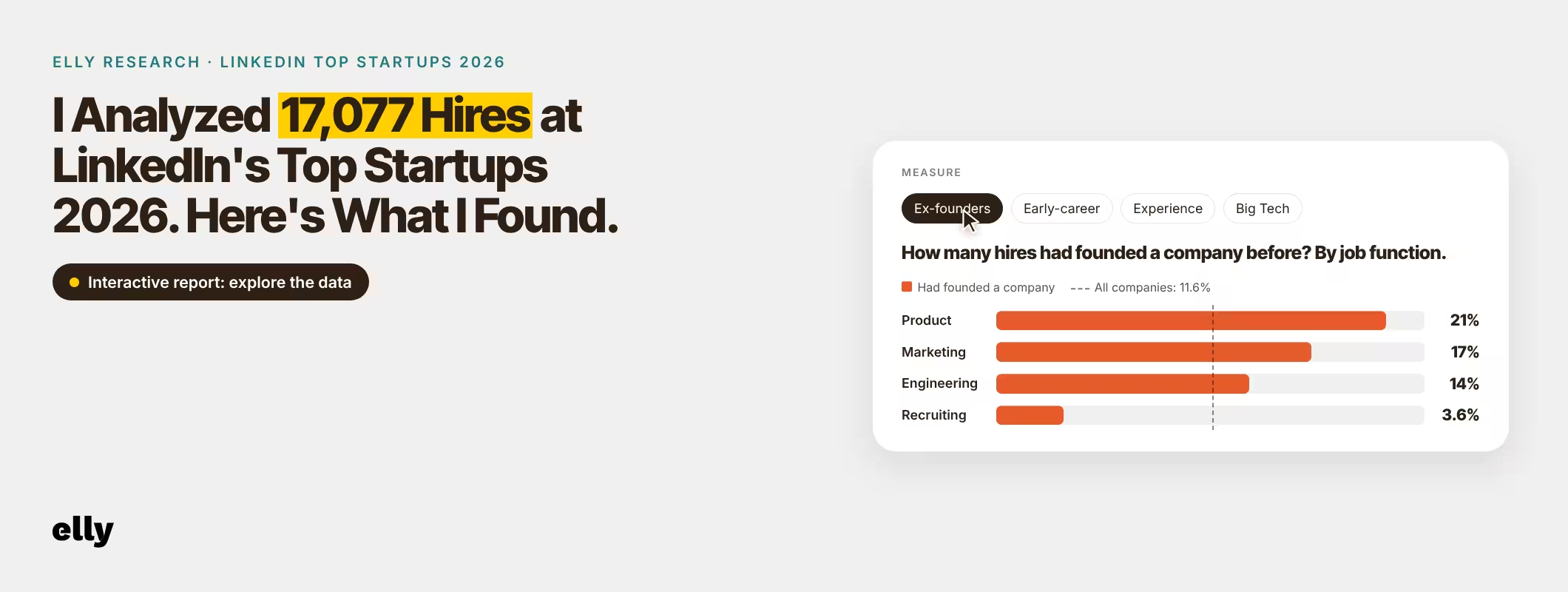
Across the hires we analyzed, 12% had previously founded a company. That number was even higher in some functions, including product, where 21% of hires had founder experience.
This was probably the most surprising finding for me. I expected some former founders, particularly in leadership roles, but I didn't expect the numbers to be this high across the organization.
Thinking about it more, I wonder whether we're seeing some of the effects of how much easier it has become to start a company. With AI lowering the barrier to building software and getting a business off the ground, it seems plausible that more people will have some founder experience earlier in their careers.
The finding also reminded me of a recent post from Jason Lemkin, founder of SaaStr, about why he advocates hiring former founders. His argument is that they've developed skills that can be difficult to find elsewhere, but he also cautioned that the experience of being a founder can take a lasting toll.
I think both sides of that are worth considering.
Someone who has tried to build a company themselves may have experience working across product, sales, marketing, and customer development in ways that aren't always reflected in their job title. They may also understand the ambiguity and pressure that come with building something from scratch.
But a founder title alone doesn't tell you what someone learned from the experience, how they performed, or whether they're ready to take on another role. The circumstances of their previous company and what they actually did there matter much more than the title itself.
3. B2B and consumer startups build very different GTM teams
One of the clearest differences I found was how B2B and consumer startups structure their go-to-market teams.
Among the 11 consumer startups in our comparison, eight hired marketing before sales. Among the 26 B2B startups, only six did the same. The other 20 hired sales first.
The composition of those teams was just as different. At B2B companies, marketing accounted for only 14% of GTM employees, compared with 52% at consumer companies.
I think this largely comes down to how these businesses acquire customers. Consumer companies may need to invest more heavily in marketing to build awareness and drive adoption. B2B companies, particularly those selling directly to other businesses, often rely more heavily on sales teams to reach buyers and close deals.
For founders deciding who to hire first, I'd start with how the business actually acquires customers. Do you need to build awareness and generate demand, or do you need someone who can get in front of potential customers and close your first deals?
The differences suggest that there's no single template for building a GTM organization. The right mix of sales and marketing depends on the business you're building.
4. Almost half of these startups have more GTM staff than product and engineering
I also looked at how companies balance product and engineering with go-to-market.
Of the 41 companies in this analysis, 19 had more GTM employees than product and engineering employees. Across the 40 companies where the ratio could be calculated, the median company had about 1.25 product and engineering employees for every GTM employee.
I think this is an interesting counterpoint to the way we often talk about startups, where so much attention goes to the product and engineering team.
I also think we may be starting to see the shift to distribution being the last moat. Products are increasingly easy to duplicate and copy with the rise of AI. Actually getting your product in front of the right people is becoming that much more important as a result.
Especially since these are some of the fastest growing startups I wonder if we are starting to see what AI-enabled teams will look like going forward.
What I took away from the research
I went into this wanting to understand how some of the fastest-growing startups actually built their teams. I had run a similar research project aggreating startup lists from a few different sources, but when LinkedIn released their annual list of top 50 startups, I wanted to dive a bit deeper into who they hired.
What stood out to me was the variety. These companies hired plenty of experienced people, brought in people with founder backgrounds across different functions, and approached go-to-market differently depending on the business they were building.
I wouldn't take any of these findings as a blueprint for how every startup should hire. The companies on the list vary in size, sector, and stage, and we haven't established that any particular hiring pattern caused their success.
But I do think looking at the career histories of people at these companies gives founders a useful starting point for thinking about their own hiring decisions.
Instead of asking what a typical startup team should look like, it may be more useful to ask what kinds of experience the company needs next, and how that changes as the business grows.
Explore the full research
These are just a few of the patterns I found. The interactive report lets you explore hiring histories and team composition across company size, age, funding, sector, job function, and more.
Explore the full Top Startups 2026 hiring report →
About the research
We used Elly's internal data to analyze the career histories of 17,077 hires associated with 47 companies on LinkedIn's Top Startups 2026 U.S. list. The analysis includes people who currently or previously worked at these companies, allowing us to look at their backgrounds before joining, rather than only examining the teams as they exist today.
The founder counts cover all 50 companies on the list. The first go-to-market hire comparison covers 37 consumer and B2B companies. The product/engineering-to-GTM comparison covers 41 companies, with the median ratio calculated across the 40 companies with at least one GTM employee.
Work experience is measured from each person's first non-intern job. Founder experience is based on founder titles listed on LinkedIn and may undercount people who founded companies without listing a founder title.
This research describes observed career histories and hiring patterns. It does not establish which hiring decisions caused a company to succeed or whether particular backgrounds predict employee performance.